Thursday, August 24, 2006

Chocolate Saves Local Gardener From Too Much Rain!


Dirt Diva Two

“Man Nearly Killed by Monster Vat of Chocolate.” Mmm, headlines make me hungry. It’s raining and blowing and raining and . . . well, you get the picture. There’s no way I’m going to go out and garden in this deluge. The plants are soggy, the raspberries are soggy, the rose buds are brown mush. It's perfect mushroom weather. I feel like I’m turning into a mushroom with all this rain. It’s 44 degrees out and it’s not even September! So, I’m sitting here cruising the internet, thoughts of hot chocolate mushrooming through my thoughts. I pull my sweater up to my ears and mindlessly type ‘chocolate gardening chocolate gardening’ on the Google search bar. Surprise!

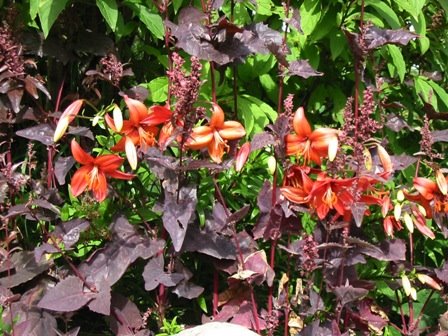
Lily 'Coral Butterflies'

& Atriplex hortensis

There are references to chocolate, gardening, and flowers galore! Well, not actual food chocolate, but, plants the color of chocolate and some that smell like chocolate. Apparently, chocolate is the ‘new’ black - the ‘in’ color for modern gardeners. Browns, tans, black, wines, and maroon, all make up the more flexible dark gothic colors of the chocolate garden scheme. They even had a chocolate garden at the 2005 Chelsea Flower Show inspired by Willie Wonka and the Chocolate Factory. The Roald Dahl Foundation Chocolate Garden, designed by John Carmichael, had cocoa pod-like gravel and a water fountain that seemed to flow with chocolate. Hmm. Chocolate scented and colored flowers? Okay, I’ll bite. Let’s see what will grow in our zone 3 gardens shall we?

I know my Columbines, the black and white Aquilegia vulgaris ‘William Guinness’, and the deep wine ‘Ruby Port’ will qualify. Aquilegia viridiflora ‘Chocolate Soldier’ actually smells like chocolate, but, it’s only about ten inches tall, so, you’ll have to get down on your knees to enjoy it! The Sweet William, Dianthus barbatus, ‘Sooty’ is almost black with deep purple flushed foliage and would look lovely paired with the columbines. Bugleweed, Ajuga ‘Chocolate Chip’ or ‘Caitlin’s Giant’ have deep chocolate colored foliage and pretty blue spikes of flowers. Don’t forget the Heuchera family which has many dark wine to almost black-leaved members like ‘Chocolate Ruffles,’ ‘Palace Purple’, or ‘Plum Pudding.’ Throw some butterscotch on top with the hot gold Heuchera ‘Marmalade’ for a mouth watering effect.

The tall Hollyhock Alcea rosea ‘Nigra’ has satiny black flowers which are beautifully set off by annuals like deep gold or wine red sunflowers (for a photo see August 10th posting on www.woolwood.blogspot.com), deep burgundy sweet pea ‘Midnight’, the black bachelor’s button ‘Black Ball’, and Nasturtiums ‘Black Velvet’ or ‘Mahogany.’ Asiatic lilies like deep maroon 'La Toya' or 'Nerone', the white ‘Tinos’ with her deep carmine throat, or chartreuse ‘Latvia’ with a maroon stardust pattern will look lovely as well. Add some contrast with golds and yellows for a hot look. For a cooler effect try annuals like white Borage and Cosmos or the perennials Thalictrum rochebrunianum, a tall meadow rue with delicate lilac rose flowers and the white
Monkshood ‘Ivorine’ and shell pink ‘Carneum roseum’.
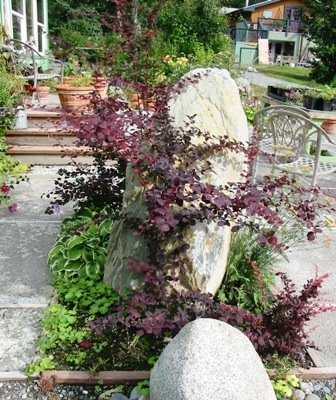
Berberis thunbergia 'Crimson Velvet'

If you’re lucky to have a Canadian red-leaved choke cherry tree and the maroon leaved shrub Physocarpus opulus ‘Diablo’ you could have a garden room planted in all wine, maroon, black, and deep reds. Actually, gardens designed around one color scheme are very cool. Instead of planting a lot of just one kind of wine red lily, try to find several different shades of wine red and black lilies to plant together. This livens up the colors and keeps them from being too ‘flat,’ a problem that often plagues plantings of solid colored lilies.

The trick is to place these dark colors so that they don’t disappear from view. Either use them as background to highlight a bright colored specimen or place them in the foreground in front of lighter colors. I read where a British garden designer actually held up a bar of chocolate, squinted one eye, and perused the dark heart of his chocolate garden. He claimed the Cadbury’s bar “disappeared” into the color scheme thus the design was a success. No doubt he said that while tucking his chocolate stained hanky back in his pocket. I’ll have to try that myself and see if it works! Maybe I’ll get one of those chocolate bars with lavender flowers in them to keep to a gardening theme. Well, if it keeps on raining check out this online nursery www.chocolateflowerfarm.com for some interesting ideas and garden gifts. For photos of the Roald Dahl Chocolate Garden and some terrific garden pictures go to www.mygarden.me.uk/chicgardens.htm or www.chelseaflowers2005.blogspot.com. Stoke up the fire, grab your chocolate, and relax. The weeds will wait for you.
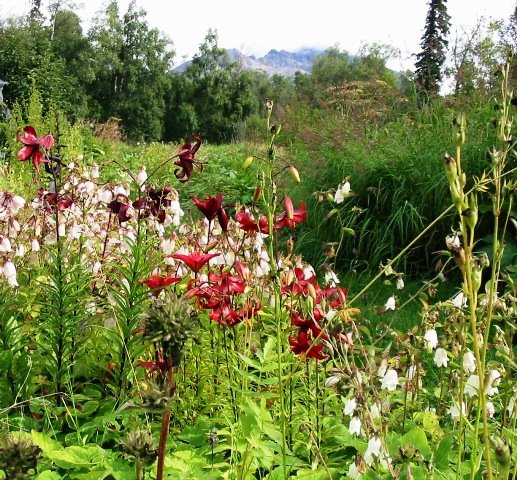
Byer's Peak in the Chugach Range with Asiatic lilies and Campanulas after days of rain.

Thursday, August 10, 2006

Late Bloomers and the Fruits of Summer’s Garden Labors

Dirt Diva Two

It always amazes me that the perennials that
color my garden in August are, for the most part, the big dogs of summer. Like fists rising from the soil, they tower above the garden in defiance of the frosts sure to come by mid-September. Magnificent Inula is opening her golden rayed flowers studded with bumblebees above huge tobacco-like leaves that glow with a fresh summer lime green. The Port Alberni tiger lily is smirking alongside with his brown freckled orange trumpets looking down at the plum blue catmint, Nepeta transcaucasica. Tall, stately Valerians are still sending their perfume out over the garden, but, will soon set their ubiquitous seed daring me to cut them before they escape to the ground. Only the Scabiosa-like flowers of the twelve-foot Cephalaria gigantea have yet to bloom. The magenta mist of the plum stemmed Thalictrum rochebrunianums is an elegant foil for the Cephalaria, reaching just a couple of feet below her arcing stems with their butter yellow stars. Even the walls of blue and purple Delphiniums are still pumping out color along with the Monkshood. I wish I had a Plume Poppy, Macleaya cordata, (one of Sally’s favorites) with its large fig-like, blue-green velvety leaves and feathery plumes of cream-colored flowers. It would be lovely next to the beefy Ligularia przewalskii’s tall spikes of yellow flowers in the shade.

Late bloomers in our gardens aren’t always looking down at us, but, many are so large that it takes all summer to grow before they can get around to flowering. Trying to figure out how to extend your garden’s bloom and color right into the frost isn’t difficult. You need to get out and visit public gardens such as the Matanuska Valley Agricultural Showcase Garden at the Visitor's Information Center in Palmer, the Alaska Botanical Garden in Anchorage, the various garden displays at the State Fair grounds, the gardens at some of the small specialty nurseries, or just take a Sunday drive to check out what’s blooming in the neighborhoods.


Asiatic lilies, particularly the tall1c or down facing types, can be in bloom right up
to the last weeks in August.The lacquer red ‘Red Velvet’is an old-fashioned small blossomed lily that looks at her feet instead of the sky. Tiger lilies are also late bloomers that come in freckled white, yellow, red, and pink nodding
trumpets. The taller varieties of Veronica should still have some bloom left and make a
good pairing with lilies. Under plant these sun lovers with some Dianthus deltoides, a creeping, self-seeding pink that comes in wine red, deep pink, or white.

Other late bloomers are Monarda, Yarrow, Sedum, and Filipendula Rubra Venusta (meadow sweet). The Sedum will need good snow cover, full sun, good drainage, and hopefully no winter rains and ice, to survive our winters. The Yarrow family tends to be promiscuous and seeds itself everywhere spreading surprise colors all over the driveway as it loves gravel and poor soils. I love volunteers and spontaneous plant surprises, but, yarrow are easy to deadhead and their seedlings easy to spot for weeding out of your beds. A member of the mint family, Monarda likes good rich soil, regular watering, and dividing to perform well or it is a short-lived perennial. Like the yarrow, it is also an herb that can be used for tea and culinary use with leaves that have a marjoram-like fragrance and flavor.

Foliage and shrubbery are an important background for the late summer garden. The annual salad herb, Atriplex hortensis, also known as Mountain spinach or Red orach, has a beautiful deep burgundy color. A relative of the equally tasty weed, Lamb’s Quarters, the leaves can be used raw or cooked and make a great floral filler for cut flower arrangements. Colorful shrubs such as the green- gold Spirea japonica varieties, ‘Fire Light’ and ‘Magic Carpet’, have a red tinge to their leaves that is enhanced by cool weather. Their deep pink flowers are an added plus in the late garden. The florescent gold leaves of Physocarpus opulus ‘Luteus’ (Ninebark) and Berberis thunbergia ‘Aureum’(Thorn berry) really set off the deep plum and rich burgundy of their siblings Physocarpus ‘Diabolo’ and Berberis thunbergia ‘Rose Glow’ and color the garden all season long.

Remember, you can plant your perennials and most shrubs as late as September, so you can still find a few bargains at the nurseries to plump up your late summer garden color. These cloudy days are perfect planting weather, so keep on gardening!

Tuesday, July 18, 2006

Be There or Be Square - The Alaska Garden & Art Festival!

DD Two

Summer is NOT over, yet!
I know we all feel like we’ve been shortchanged by Mother Nature lately, but, we do still have a few weeks left before the next frost sets in. July is the month when our gardens are really hitting their stride and a great time to get out to the garden tours. Next Saturday will be the 2nd Annual Garden and Art Festival at the State Fair grounds-an event that will knock your garden clogs off! This is the best way to enjoy all that head gardener Becky Myrvold and her staff have done with the over 35,000 plants that are planted in the beds every year along with 200 hanging baskets and 100 whiskey barrels that make the Alaska State Fair sing with color. So, stop your whining and get out to see the efforts of some real gardening athletes.

With a small crew of gardeners planting and pruning to get those great blooms for the fair, Becky hopes to be finished planting by next week. This year Becky decided to do the unthinkable-a white monochromatic color scheme. “I decided to go out on a limb and do an all white theme – so all of our beds and baskets will be all white, silver or gray and their wonderful variations! It was a challenge to myself – to see if I could create enough interest using only a monochromatic scheme. Did I pull it off? I really won’t know until later in the season.” Personally, my favorite part of my garden is mostly white with a hint of pink veronica. It just glows in the evening light! But, it’s a scheme sure to bring out the garden nannies and their grousing about color. “I suspect that the gardens will look lovely as usual, but, anxiety is part of the job. I vacillate between being worried that I have failed and being excited to see if it will be beautiful,” she noted. Becky’s really excited about the Ptilostemon diacantha, a thistle-looking plant with gray green foliage and white variegations.

Of course, it all started last fall with the seed orders and planning the garden theme, followed by the actual seeding in January. By March things are in full swing with pricking out the seedlings and starting the transplants. “The magic of seed germination” is Becky’s favorite part of the job. Going to the office in the morning to be greeted by “the beauty of a greenhouse in mid-April when all the plants are young and actively growing” is something many of us yearn for in the early dawn gloom. For Becky “the wonder of walking into the Perennial Garden and finding someone blooming I had forgotten I planted” and “poking around in the early spring for new shoots” is part of the joy of the job. You’ll notice she personifies her wards as ‘someone’ rather than as just a plant. This gardener is really ‘into’ her plants!

Part of the State Fair’s agenda is to educate the public about agriculture in Alaska. Their garden program illustrates just how many varieties of plants we can grow in our Alaskan gardens.
Like a movie director, the head gardener is invisible in the wings while the public enjoys the fruits of her labors. For Becky there’s satisfaction of a hard job well-done if all those perennial “plant crazies” who come each year can learn something new. And there will be lots of new things to watch for this year with the revamped plantings at Raven Hall, more paved paths in the Eckert Garden, and a picnic retreat at the Flagpole area.

Of course, the whole festival would not take flight without the unflagging efforts of the indomitable festival organizer Margo Frey, whose energies and organizational skills should be distilled and marketed as a supplement for the rest of us following in her wake! And she expects gardeners to heed the call to enter the Classy Container Contest. Do you have a stunner out there on the deck just waiting for the limelight? Well, bring that work of art to the Red Walk-In Gate on Saturday, July 22 from 11 to 2 for the judging. There will be wagons and helpers to transport your entries to the judging area. Be sure and make room for all the prizes, too!

Alaska Garden & Art Festival, Saturday July 22, 11-6, Alaska State Fair Grounds. For more information go to www.Alaskastatefair.org.

Thursday, June 29, 2006

Garden Tours to Inspire!


DD ONE

Alaska State Master Gardeners hold a state-wide convention once a year. It rotates around the state with various MG chapters hosting. Some of you may remember the last one our local chapter hosted, in April of 2001. It was a great conference with lots of speakers, wonderful seminars and an array of interesting garden related venders.

This year, the state convention once again returns to the Mat-Su MG chapter and they are aiming to correct something they feel has been missing from the state-wide conventions, including their own past efforts. Garden Tours! It sounds terribly fundamental – garden convention, garden tours, right? Well, not exactly. Traditionally the Master Gardener conventions have been held in Feb. and I need not tell you how difficult it is to have a proper garden tour that time of year! While tours of commercial, year-round greenhouses filled in somewhat, there’s nothing like getting your feet inside someone else’s garden to make a gardeners life complete. Granted it can also make one feel tortured and inadequate as you gaze on those giant vegetables and perfect roses, but what’s to inspire if not wonderful gardens? If torture is part of that, so be it.

The days to reserve are July 21 and 22. The conference starts with a keynote from Ed Buyarski, the president of the American Primrose Society. Ed is an entertaining and knowledgeable speaker and promises to fill your head with lots of practical – yes, appropriate for our area! – information on these lovely plants. In addition to Ed, Dan Elliot, past president and current vice president of the Alaska Fruit Growers Association will present on growing apple trees in Alaska. Dan has over 100 varieties of apples in his home orchard and is a wealth of valuable information on the subject. I also understand that it’s a bit of a coup to have him as a speaker.

Stonehill Gardens will be catering a dinner on Friday evening and two Local Master Gardener authors will have their books available for signing. Jeff Lowenfels has just returned from a book promotion tour for his new book ‘Teaming with Microbes’ and will be introducing it that night. Hazel Koppenberg’s cracker and flat bread cookbook ‘The Cracker Box’ will also be available. Herbal Crackers from Hazel’s book will be featured at the dinner, along side wild Alaskan foods and fresh valley produce.


An extended lunch hour on Friday will include a self-guided walking tour of gardens in downtown Palmer featuring the Dr. Myron F. Babb Arboretum, the visitor center’s agricultural showcase garden, the historical garden at the United Protestant Church (the old log church across from the borough building), and the city garden at the Purple Moose Espresso. Three additional gardens will be featured on private tours throughout Friday afternoon: an urban rose garden in Palmer and a Master Gardener’s vegetable garden will be featured. Plant listings will be provided for each tour.

On Saturday there will be another keynote from Ed Buyarski followed by a full day of classes, presentations and activities. Saturday’s events will be held at the state fair grounds in conjunction with the second annual Alaska Garden and Art festival. Between the conference and the festival, Saturday topics include composting, potato late blight, landscaping for wildlife, beekeeping, pruning, garden photography, invasive plants, an ‘ask the experts forum’ with a wide range of plant expertise, beneficial insects, garden wildlife, children’s story time, children’s ‘build a fairy house’, yoga in the garden and sand cast birdbaths. In addition there will be tours of the three main gardens on the fair grounds; the Eckert Memorial Herb Garden, the Perennial Garden and Millie’s Vegetable Garden. These gardens are the babies of Becky Myrvold, head gardener at the fair, and are well worth a look. Becky is a treasure of plant knowledge and design insight and will be giving the tours herself.

Another first for this year’s conference is a children’s forum along side the adult forum, complete with a child’s registration fee. Speaking of price, the two day conference sounds like a bargain in any gardener’s book – only $85.00 per adult and $40.00 per child!

Participation in this event will be guaranteed to turn your brain into garden mush and you’re likely to walk away spouting Botanical Latin, or even worse, discussing microbes with you neighbor! But it still sounds like a no-miss happening. TO REGISTER, JUST CALL 745-7071 OR SEND YOUR REGISTRATION FEE TO: MAT-SU MASTER GARDENERS, C/O PO BOX 2876, PALMER, AK. 99645 ALONG WITH YOUR NAME, PHONE NUMBER, EMAIL ADDRESS (IF YOU HAVE ONE)AND KNOWN FOOD ALLERGIES. It's as simple as that and you can join the fun!

Sunday, June 25, 2006

Hurray for PAR!

DD One
It’s not every day that I talk about vegetable gardening. I don’t hate vegetables – in fact, I love them! Not only are they one of my favorite food groups, they are fun to cut and chop, and look so lovely in the garden. But I don’t grow them. There’s a perfectly good explanation. I have a sister and a number of friends who have fabulous vegetable gardens. They give me veggies, I give them perennials. It’s as simple as that.

So what made me plant a vegetable garden this year? My first ever, I’m ashamed to say. No lightning bolts letting me know I’ve gone astray with all the shrubs and flowers. No fundamental conviction that I should start growing my own vegetables for a change. Just a decision to get behind a good program designed to provide food for those who need it. For you skeptics, here's a photo, but please don't laugh! Remember, this is my first ever!

The Garden Writers Association (GWA) is sponsoring a campaign called ‘Plant a Row for the Hungry’ (PAR for short). Aside from generating over nine million pounds of produce for donation last year, PAR started right here in Alaska! Garden columnist Jeff Lowenfels, (Anchorage Daily News) started the whole thing twelve years ago when he asked his readers to plant a row of vegetables for Bean’s CafĂ©, a soup kitchen in Anchorage. Since then, with the sponsorship from GWA, the program has spread across the country and has begun to make a significant contribution to our country’s hunger plight. According to hunger statistics from the U.S. Dept. of Agriculture, over eleven percent of American families experienced hunger in 2005. There are an estimated ninety million gardeners in the US today! Think of the hungry we could feed if every gardener planted just one row or donated their excess produce each fall to their local food bank? You got it – that’s the whole idea!

PAR follows in the footsteps of the great War Gardens of ninety years ago. This was a very successful campaign launched during World War I, again, from the inspiration of one man, Charles Lathrop Pack, who set up the national War Garden Commission to organize his brain child. The posters showed militant vegetables marching off to war calling “The seeds of Victory ensure the fruits of Peace!” Later, when the war ended, posters boasted victorious vegetables returning home holding high the American flag with the words “War Gardens Victorious, Every War Garden a Peace Plant!” Canning was the most common form of food preservation at the time and there was even a poster encouraging people to “Can Vegetables, Fruit and the Kaiser to”.


The war garden effort, promoted both here and in allied countries, is largely attributed for saving Europe’s food supply during the last two years of the war. By 1916 major portions of farmland throughout Europe had been devastated by war and food reserves had run out. Solders were getting what food rations were left and not much at that. Their families at home were getting even less.

Our country had entered the war late and was not fighting on home soil. As a result, our cities were in tact and we still had healthy, strong citizens who could garden. Why not put these people to work growing food? The War Garden program went beyond home gardening in their effort to feed the troops. Vacant lots, primarily in the US, but also in Britain, France, Belgium and Italy were put into the cultivation of vegetables. The emphasis of this program was in the cities where there were people to man the gardens, mostly ladies groups, Girl Scout troops and hastily formed garden clubs. A survey conducted by the War Garden Commission in 1918 conservatively estimated the number of such gardens in the US at just over five and a quarter million, with some 186,000 vacant lots under cultivation in New York City alone!

PAR is similarly successful because of individual gardeners volunteering their effort to grow food and make sure it is being donated where it needs to be. To join this effort, just designate a portion of your garden as ‘A Row for the Hungry’, it’s that simple. To find out where to donate your produce, call your local food bank, Master Gardener's organization or PAR's toll free number 877-492-2727. There are volunteers all over the country working with this program. Why not make this your year to join?

Confessions of an untidy gardener

DD One
This time of year is always a hard one for me. You’d think I would be whooping for joy – the grass is up, the apple trees are in bloom, the perennials are growing, the alpines light up the nursery and we’re making money. Instead I am grumpy, annoyed and making life miserable for all those around me. There’s a persistent nagging in the back of my mind that I should be somewhere doing something that I’m not. There’s always an unfinished list on my desk and uncompleted tasks in my garden book. It’s all about time and I don’t have enough of it.

Which dragons do I slay and which do I leave standing? Oh dear, oh dear! The dandelions must at least be headed before they start to fly, the tree seedlings need to be removed from the garden before they grow strong and root deep, and any remaining winter die-back on the shrubs needs to go. Really, it is June already! Aside from that, I don’t know where to turn, the list just goes on and on.

I suppose all of you organized decisive gardeners know exactly what you’re up to. I see you out there digging, raking, lifting, separating, cutting, planting and trimming and I am jealous. Yep! Jealous! What a life! Not me and my garden. We are, at best, a disheveled, overgrown partnership of compromises. Mysteries lurk behind each rose bush, surprises in each patch of currants. And nature abounds.

Birds aren’t especially fond of tidy gardens, which makes them feel right at home in mine. Robins have built a nest in the atrium and talk about untidy! Twigs and grass everywhere, which of course I won’t pick up - that would just be wrong. There’s a pile of garden scraps by the alder patch that stayed one day too long and now must stay for the summer. A mamma Junco chose to make her home in there. Soon she will be dodging garden traffic as she darts in and out of the pile to feed her young.

The bugs in the old, dead birch are a feast for the Woodpeckers, both Downy and Hairy, bringing such wonderful rhythm to the twittering air. A bedlam of songs greet us when we step out of the house in the early morning. By mid day they have ebbed, only to pick up later in the evening and continue late into the night. From the look of the activity in this unruly mess, I know we would be missing a lot of life if we cleaned the place up.

In the heart of the garden, Dragon Fly larvae are thriving in the pool. It’s all those dead leaves in the bottom! A lingering sit on the ground by the water, looking into the shallows will reveal a long list of little critters to ponder, as well as a chance to take note of the visitors nearby. Chickadees busily explore the larch tree, Robins hop about after worms and bugs, and, if you’re there very late, when it’s nearly dark, you can feel and sense the little brown bats swooping past your head in pursuit of the dreaded mosquito. All these wonderful creatures are comfortable guests in their disorderly home.

So while I ponder the tidy gardeners and wonder at their organizational skills, my little jungle thrives. Every time I get brave enough to plunge into the cluttered chaos with my trowel in hand, I get lost in its magic and do just about nothing. Oh sure, the paths get narrower every year, the bushes more ragged, the pond smaller, the ground cover larger and the rock work less visible, but what’s a nature lover to do? I planned all this, after all - the right selection of shrubs, the location of the pond in filtered shade, the apple tree arbor, the crazy lilacs and those out of control currants. These were all by design to do exactly what they are doing now – attract life to the garden. So now that they are doing their job, who am I to tidy up?

The moral of the story is this: choose your garden design wisely, for it may bring just what you hoped. Tidy rows of organized, back breaking beauty, or relaxed disorder - or it may be that I’m just a lazy gardener. Either way, this is for all you who love to garden but just can’t be perfect. Don’t sweat it, perfection isn’t natural anyway.

Sunday, May 28, 2006

Reliability at Ground Level


DD One -


If you think of ground covers as carpets for the floor of your garden, you may begin to look at them in a different light. Just like floor coverings in our own homes, each area of the garden has a different use – so choose each ground cover carefully.

For those areas of the garden that are dark, shady, boring and hard to grow in, try one of the many lamiums. These hardy perennials come in an assortment of leaf color from white/green variegated to lime green. They are often used as an annual in hanging pots or containers because of their ability to droop over an edge. These plants are dreadfully under-used as ground covers. I have a fabulous patch of Lamium maculatum in my garden that is all shades of variegated from white to dark green to maroonish/purple, and that’s just the leaf color! The patch collectively blooms pink to purple to white! I didn’t even plant this lovely colony, but it made its way there and settled in, for which I am eternally grateful. It lights up the shady side of the path and looks too fabulous in the fall with golden birch leaves sprinkled on top (see photo above). This is not a ground cover to be walked on and never wants to dry out, but it makes up for these shortcomings in beauty and steadfastness.

If you want aroma, reliability, usefulness, mow-ability and beauty, all rolled up in one, Mentha arrensis (Wild Montana Mint), is hard to beat. Yes, it does provide all these things, and makes a great mint slushy as well! People’s eye brows go sky-high when I recommend it, but it really is a great plant. It’s not as invasive as most members of its family (at least not up here in the North Land) and it tastes SOOO good! It grows up to 12 inches in the sun, and a bit taller in the shade (it can grow in both). It grows without much water, or in moist soil. It doesn’t particularly care what type of soil it is given, responding to conditions by adjusting its size. Tea made from this wonderful little plant tastes like it’s had honey added to it – there is no bitter taste and it can hardly be made too strong. Mentha arrensis can even be kept short by mowing!

Recipe for Mint Slushy

1 large handful of Wild MInt (Mentha arrensis)
2 cups cold water
1/4 cup raw sugar dissolved in 1 cup warm water
2 cups ice cubes

Mix all ingrediants into a blender at high speed until it is the consistancy of a smoothy. Serve with a sprig of mint on top - preferably in a small glasss shaped like a flower pot!

A combination of slow growing ground covers can serve an all together difference purpose and provide a different look. For example: try combining Moss Campion (Silene acaulis) with its glossy green mat and bright pink flowers with the fuzy gray/green carpet and soft purple blooms of Wooly Thyme (Thymus pseudolanuginosus). These two plants have a similar growth rate, share a love of sun and good drainage and form mats at ground level. Twining together over rough terrain, they are indeed a handsome coupling. They are perfect to plant along a rock pathway, on stone steps or on a rocky hillside. Throw in some Veronica prostrate ‘Aztec Gold’ with its golden/lime foliage and you’ll think you’ve died and gone to horticultural heaven. Really, you will! The wonderful blue blossoms on the Veronica are just a ‘way-too-fun’ extra!

The best thing about a reliable ground cover is that it’s reliable! You never have to worry about that part of the garden again! If chosen carefully, to suit your needs, a ground cover should do just what its name indicates – cover the ground! It should also look beautiful, make you smile and perhaps, with luck, you can make a pot of tea from it as well.


Monday, May 22, 2006

Freeing the North American Lawn Slave

DD One


I think the official color for May ought to be taupe. You know, that almost brown, sort of dusty ‘blandscape’ overlaid with chilly gray overcast skies. This isn’t exactly the sort of weather and tone that makes me want to even think about gardening. But, you can already hear the low buzz of the early prowling lawn mowers and the dull whining of from folks complaining about their neighbor’s lawn care; a sure sign of spring. The North American lawn could be one of the most successful behavioral controls ever invented. Think about it. Lawns and turf take up over 30 million acres of land making it the fifth largest crop in North America. There are approximately 38 million lawn mowers dragging North American slaves behind them all summer long. Maybe it’s time to think about freeing our selves and our property from the insidious and destructive institution of sod!

Think about it. Between 1996 and 2004 more than 663,000 of us were treated for lawn mower related injuries in hospital emergency rooms. That’s about 2 out of every 1000 injuries in the ER! Many of those injured are under the age of fifteen or over the age of 60. But, the lawn mower itself isn’t as dangerous as the lawn owner. Americans apply pesticides, fertilizers, and herbicides to their lawns at about four times the rate as applied to agricultural crops. According to the US National Cancer Institute the incidence of childhood leukemia is approximately 6 ½ times greater among families using lawn pesticides than for those who do not.
Fertilizers and lime are applied religiously by homeowners who rarely, if ever, have their soils tested to see if they are even necessary. Many of the chemicals applied to our gardens and lawns find their way into our water supply. A 1990 EPA survey found that 12 of 32 untested pesticides and herbicides made it to their water testing sites. We spill nearly 15 million gallons of gasoline a year while filling these slave masters. Yale forest ecologist, F. Herbert Bormann estimates that we burn about 580 million gallons of gas mowing the lawn annually while polluting the air in one hour as much as driving our cars 350 miles!

Think about it. In the American west approximately 60 % of urban fresh water is used to irrigate our lawns. It takes a lot of energy to maintain water quality, run the wells, pumps, an the water stations just to keep junior in the shower for an hour, let alone to water the lawn! And we’re doing all of this why? Because we’ve bought into the idea that a green lawn and lots of it keeps nature at bay, is an important asset in a neighborhood, and our neighbors expect us to toe the line. In fact, in some places it’s the law that you only have lawn in your front yard. Maybe lawns are just too dangerous and expensive to consider as an asset anymore. You can’t eat your lawn, it’s hard on the environment, and takes a lot of money and work to maintain. So, if you wanted to work hard on your yard wouldn’t you want to work at something with more bang for your buck?

Why not cover some of that lawn with some raised beds filled with exotic herbs and vegetables? You could learn how to grow and cook your own delicious meals. You don’t need lots of lawn for a great garden party, but, you do need good food. Replace that blandscape with flowering kale, colorful varieties of loose leafed lettuces, golden zucchini, rainbow colored chard, lemon thyme, sweet marjoram, and lots of nasturtiums. Wouldn’t you rather spend time with your spouse sitting on the bed doing a little weeding and discussing some exciting new recipes you both want to try? Take a cooking class and renew your relationship with your garden and your former lawn slave!

Try using the lawn as an accent to borders of perennials and shrubs and you’ll have a ready source of material for floral arrangements that will make you the envy of your friends. Children will have more fun hiding around large planted beds than pushing the lawn mower. Pets can be compatible with plantings if you don’t stress out over every little accident. Gardens should be relaxing and enjoyed, not as places to shackle ourselves to expectations of others. That’s what lawns are for. Think about it!


Thursday, May 11, 2006

Contemplating A Late Spring

DD One
About now we’re thinking that a mini-ice-age has set in and we’ll never see summer again! Well, I suppose that could happen, after all, my Mother remembers the May of 1955 when the leaves didn’t open until after Memorial Day weekend! Let’s hope it’s not our turn for more of that! In the mean time it is cold out there, the wind is nasty and persistent and there’s not much popping out of the ground. So what’s a gardener to do?

Why not take advantage of what has been forced upon us and see what the really hardy stuff is out in the garden? What has popped out of the snow? Has anything set bud yet? Is anything in bloom? (not likely) It’s really great, if you think about it. If you’ve been afraid to walk through your garden, put on a warm coat and head out there now. You may be surprised and delighted at what you find. Here’s what I found today.

The champion in the ‘three inches above the soil’ category is the garden primrose, Primula auricula. It even has some little buds! At an even tie are Native Alaskan Chives, Allium schoenoprasum sibericum. They’re up three inches, budded for bloom and taste great to boot. Coming in a close second would have to be Lewisia tweedyi. This fabulous little plant comes out of the snow pretty much as it went in. Perfect, small rosettes of reddish-green succulent leaves are doing their best to cheer up the scenery. Along side this, of course, is Berginia cordifolia. Considered semi-evergreen here, it usually thaws out a deep reddish maroon. A wonderful, rich color in any garden when surrounded by so much brown and gray! Both of these early birds will bloom soon. And then there’s Draba siberica. This flat, ground mustard is a delicate, light green mat bursting with buds. It will be a carpet of yellow within a day or two and will have rushed to first place on my list. While it is a bit untidy when not in bloom, it is irreplaceable for early garden color. Bright and cheerful, it will hold bloom for three weeks if the weather is cool. Flat sedums such as Dragon’s Blood and Variegated are lovely right now, with fleshy leaves and bright red stems. What little troopers!

Runners up, should not be
shunned. Various Delphiniums are 2 to 3 inches out, with their green leafs looking like little fisted hands emerging from the soil. Native Iris, both standard and dwarf (Iris setosa and I. setosa nana) are cutting through their frozen homes like thick grass, forming bud heads as they come. Another wild Alaskan favorite of mine, Antennaria microphylla (pink pussy toes), is living up to its ‘favorite’ category by melting out of the ice in full, soft gray color. Its simi-fuzzy leaves and flat, matting form make it look like a silver carpet on the brown ground. It even feels good to walk bare-foot on, if you’re brave enough to take your shoes off and give it a go!

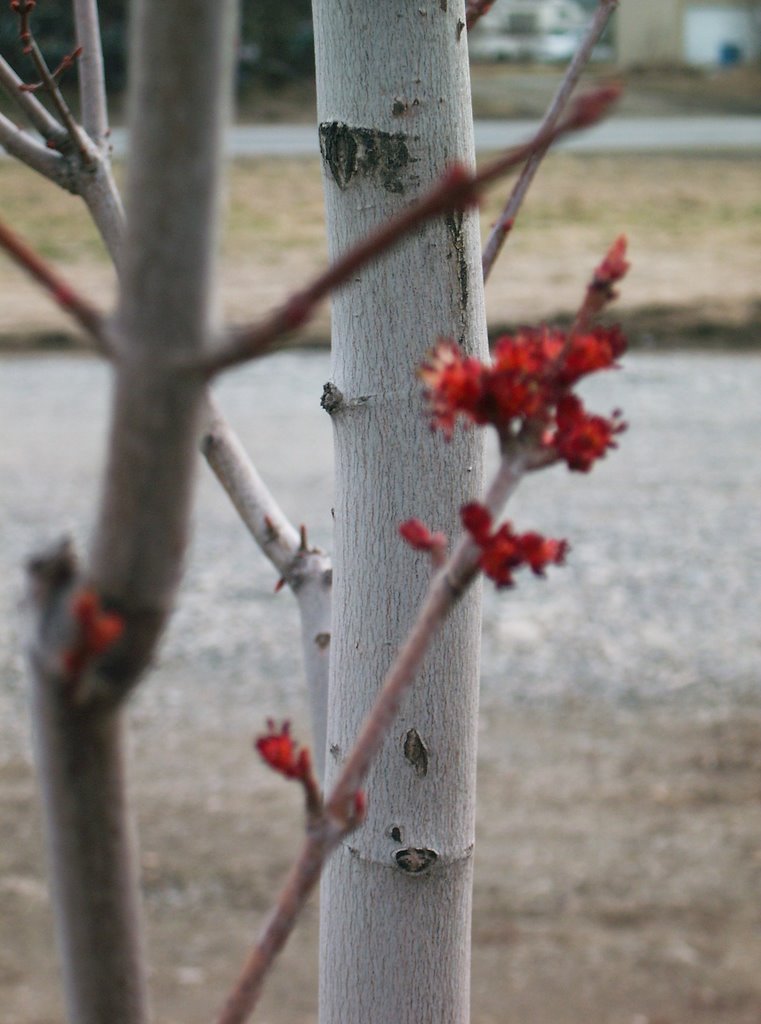
In the shrub and tree division, the Prunus virginiana wins hands down. This wonderfully hardy tree, known commonly as a Canadian Red, can’t be beat for early leafing. While we are surrounded by native trees too afraid to let out their greenery, this imported ornamental just plunges ahead without trepidation. No cold wind or freezing nightime temperatures are going to stop it from enjoying spring! It has leaves and flower buds that grow daily. It’s neighbor, the Northwood Maple – Acre rubrum ‘Northwood’ - positively delighted me with blooms this year! Arn't they beautiful?

Tuesday, May 02, 2006

Picky Plants Make Perfect Gardens

DD One

We have lost the idea of joint residency as we segregate in huge homes, gate off our communities and work at jobs that are increasingly specialized. We like to categorize, cube and divide. It is natural to bring this concept into our gardens as well, but I’d rather think of the garden as a place where we can bring back into practice the art of harmony.

This time of year we are all reading plant labels and now have a list of plants for the perfect garden. But your desired lovelies come from such varying cultures, will they ever get along? Fear not! With a little technique, many plants of opposite needs can be very happy living together.

The ideal garden would have a number of mini-environments and is not all that difficult to create. Once done, it should fill the needs of a diverse group of plants. A verbal illustration of such a garden built on a site with full sun, might look something like this.

Aligned each corner of the garden with a compass direction. Shade is created by building a garden wall on the SE and SW sides of the garden and by planting an Amur Maple (Acer ginnala) in the southern most corner. A little wet ditch runs inside the wall as it follows the garden perimeter. The mound on which the tree is planted is made of very lean soil and grit. The wall, tree, mound and ditch will provide moist shade, dry shade and wet shade. Voila! Bob’s your uncle and you can now plant your Touch-me-nots!

A fence could replace the wall, a large, shade loving shrub such as a Kesselring Dogwood (Cornus alba ‘Kesselring’), could replace the tree and so forth. You get the idea.

A benched pergola anchoring the northern corner of the garden, serves as an entrance, a place for your Arctic Kiwi vines to flourish, a welcome resting place and a little filtered sun. Flank it on both sides by a hedge that runs to meet the garden wall in both directions. William Baffin Roses would work well for this. They will thrive in the heat, especially with the little ditch feeding them a constant supply of moisture. You have now completed the outline of the garden and have created filtered sun by the pergola, full sun in the garden center, wet partial sun/light shade along the rose hedge as morning and evening sun rotates, and moist sun along the inside of the ditch. A low, raised area somewhere in center of the garden made of lean soil will supply you with the one, remaining growing condition you lack; dry, hot sun. How hard was that? You’ve now got it all and can happily go bonkers planting a diverse and interesting haven.

A couple of things to remember before you get too crazy. The little ditch will need a liner, fairly deep down - around twelve inches - to keep the moisture in the general area you intend it to be. The dry areas work best if bordered by wet areas or well drained walk ways to collect the moisture that will naturally drain through the gritty, lean soil during times of precipitation. The overall amount of sun or shade in you garden is up to you. In following this plan, for example, the larger the garden area, the more full sun you would have within its center. And finally, while it is rare to see a wind warning on a plant label, it is helpful to know your wind direction as well as your compassing.

Planning and planting a diverse, mixed garden is a tremendously rewarding experience and can readily expand the horticultural gray matter. Up here the leaves aren’t even out yet! I’d say there’s still plenty of time to plot and scheme while we ponder that perfect plot.

Monday, May 01, 2006

Cottonwood Beauty!

Posted by PicasaDD One

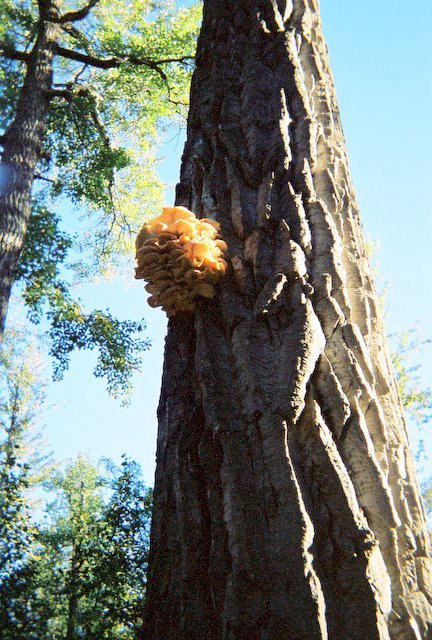
This Cottonwood stands straight and proud in the River Park near Palmer. I watched this Coral Mushroom form over a number of weeks in the fall of last year while on walks with Rosemary and Basil.

Such simple beauty.

Sunday, April 30, 2006

In Defense of the Cottonwood

DD One
Finally, a new garden club to join! And this one is for the underdog, what more could you ask for? It's really easy - just log onto comments and tell us you're in. ‘Save the Cottonwood Society’s time is here!

Populus balsamifera ssp trichocarpa, known more commonly as Black Cottonwood, or just ‘cottonwood’ here in our Valley, is spectacular, underrated and abused. If it sounds like I’m about to defend this tree, you’re right. It’s been systematically annihilated for years. It’s a big, humble tree that’s treated like a dispensable weed. Well, it’s neither a weed nor is it dispensable. If you’ve chopped them down and cursed the name, please read on. This column’s for you!

Cottonwood can reach amazing heights – up to one hundred and twenty feet! This makes it the tallest broad leafed tree in Alaska. Its rapid growth habit means you don’t have to wait your whole life for the wind breaking and shade giving qualities it provides. We have a lovely, thirty foot specimen in our back yard that wasn’t even there when we moved in twelve years ago! This photo shows an award winning garden in North Palmer. The gardener’s have groomed a pair of these giants for years. It is a thing of beauty and shelters a small patio under its wonderful branches.


Cottonwood also can keep the air in your garden clean. Read on.

The soil surrounding these trees nutures a colony of special macrobiotic organisms that live only around cottonwood roots. These organisms transfer carbon from the tree roots to the soil. Carbon is also captured in the above ground portion of the tree which, when combined with the root community, creates a system of air filtration for the carbon dioxides emitted into our atmosphere, and effectively slows the increase in harmful atmospheric carbon dioxide concentrations. While all trees perform a similar duty, the cottonwood has one of the fastest and most efficient rates of carbon sequestering. Cottonwoods also increase soil’s fertility and ability to hold water. This saves on the need for erosion control as well as cutting down the need for manmade, fossil-fuel- eating, fertilizers. Important stuff! After all, what is the plan for dealing with our atmosphere when our trees have been reduced to a marginal level? I don’t have one, do you?

The waxy resin in cottonwood buds is used by bees to caulk, and seal out intruders such as mice, or other insects that might bring disease and destruction into their hives. The chemical in this resin is also being developed for tree trunk paint to keep rabbits and mice from girdling them in winter. The same resin holds anti-infectant properties and is used in many modern health ointments and soaps. Soap made from the early buds is magical. It leaves the hands feeling clean and smooth as though lotion had been applied. Of all the wonderful herbal soaps my Mother makes, her Cottonwood Balm is my favorite,and soooo good after a long day in the dirt.

The deep, cracked bark of this mighty tree is a major over-wintering habitat for butterflies, bats and spiders. Cottonwood trees are also a valuable bird sanctuary and their foliage, twigs, buds, flowers and roots provide food for many small creatures, such as shrews, voles, squirrels, porky pine and beaver.

My father, Jerome Koppenberg, is one of Alaska’s most knowledgeable log home builders, and while he prefers using spruce because of its relative lightness, easy peeling and cutting, he says that cottonwood is not without value. As a testament to this, there are two wonderful, cottonwood log homes, built by him, on Lazy Mountain. He lists, among its attributes, its height and straightness, its size – each, single, round easily replacing several of spruce, its superior insulating qualities and its longevity.

Now, lets talk about what you’ve all been waiting for. The cotton! For starters, not all trees produce the dreaded stuff. While both male and female trees can potentially flower, the male catkins are fairly cotton-less and only get up to a couple inches long. The females are the trouble makers with catkins up to eight inches long! But even these beauties, if kept in the back yard or on the edge of your woods, should be welcome. No flowers will appear until the trees are ten years old. Think of the joy and the height a cottonwood can bring you in ten years?

Converted to a cottonwood lover? Good! Remember, cottonwood can only provide its many benefits if left standing. Embrace these majestic giants and enjoy a warm, fuzzy feeling every time you swallow cotton on the breeze. One more thing! Don’t forget to join the ‘Save the Cottonwood Society' and tell us your favorite Cottonwood story. It’ll do your heart good.

Monday, April 24, 2006

If you can't weed them, eat them!


DD Two

Some cultures eat the heart of their adversaries both as an homage to the enemy’s courage and strength and to strengthen their own ! Hey, whatever works to get rid of these weeds . You can do a delicious stir fry with young fireweed and cucumber berry stalks, fiddleheads, stinging nettles, plantains, and that old stand by ...the dandelion. Stinging nettles are both an indicator of good soil fertility as well as a very mineral rich pot herb. Once they’re cooked they no longer sting. Just wear some gloves when picking them.

Warm Dandelion Greens
Fry 2 0z. Diced lean or Canadian bacon in a large skillet for 2-3 minutes, until edges curl. Drain on paper towels. Pour off fat and add 2 tsp. olive oil. Add 1 clove garlic, minced, and saute until light brown. Add 12 cups young dandelion greens, rinsed well and briefly shaken dry, stir to coat with the oil, cover pan and steam about 3 minutes, or just until limp. Add 2 tbsp. Balsamic vinegar, the bacon, toss lightly and serve at once with dandelion flowers and leaves for garnish. Serves 6

Sunday, April 23, 2006

Snow, Snow, Snow! Will it ever end?


DD One

Unlike Brooke, who is soooo lucky to have a fabulous greenhouse with wonderful artwork hanging about, we have a field of snow (to which I have referred several times already). Yes, I know, it's all quite boring, but while others are posting information on lovely plants popping up out of the ground all I get to do is watch the snow melt. Check out these picture! We had two inches of snow overnight! This, of course, on top of plenty that's still there.

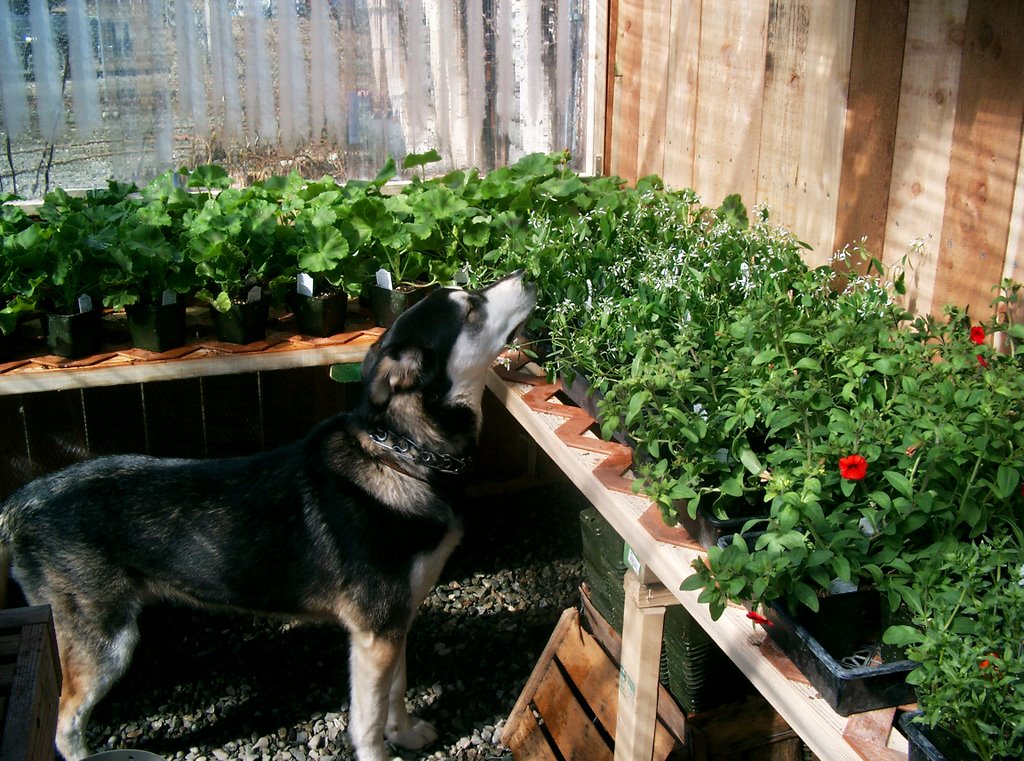
SO, I am thrilled that our tiny little house at our downtown outlet is is FINISHED and full of plants! Thanks to my friend Nancy, who grew the babies for me this year, I don't have to wait. Nadia and I have already planted most of our special-order containers and have now moved on to fun things. Our new baby, Chervill, loves to help out but looses interest pretty quickly. Such are the ways of a 12 month old puppy.

I have been looking at Basil's puppy pictures - way too cute! Rosemary was PLAYING with Marley and Chervill today! I was so happy for her. Perhaps she's learning how to get on....good girl! The flowers are cheering me up. May be I need to do more annuals, they really are wonderfully cheerful.


Wishful Thinking


DD One

Rudolph Crabapple and Darwin tulips on May 14, 2005 in the Colony Garden at the United Protestant Presbyterian Church in Palmer, Alaska. I don't think we'll be there quite that early this year. The tulips are only 2 inches high today and they're not looking all that happy.

Another thrill of the North Land...constant climate changes and grossly unpredictable weather.

On this day last year I was planting perennial roots by the hundred on an outside workbench in 72 degree temperature! The ground at the nursery was mostly thawed. The perennials were placed on the ground under plastic that actually had to be removed during the day because of the heat. It was 45 degrees today with rain and snow and a chilly breeze. The nursery still has at least a foot of snow with more in many places. Last year Rosemary and Basil were playing on the snow bank behind me. This year Rosemary plays with her new friends and Basil romps above, perhaps with Bear-Bear or TD, his bones burnt and in a tin waiting to fertilize tulips in the garden. Change is constant and certain, companionship is not. I think it best to enjoy blessings we have while we can, like today's moisture. It will soon surround us in green.

Don't Treat Your Soil Like Dirt

DD One

Dirt Divas column from May 10, 2005

To have great plants, you need great soil. This is not a mystery. We live in one of the best agricultural areas in the world, renowned for its soil (really), but many a manic gardener lives in the surrounding gravel and swamp. So, we buy soil, usually a ‘three-way’-mix’ – 1/3 top soil, 1/3 humus, 1/3 sand. These mixes vary greatly, depending on where the parent ingredients come from. They range from OK to not so good, but all fall short of being the Holy Grail of garden soil. A little care to the under layer of your garden now, will reap amazing results later.

Soil needs several basic things, nutrition, airspace, drainage, and humus. To address these needs the ‘squeeze test’ works well. That’s what’s going on when you drive by a farm and see folks hunkered down in a field, hands in the soil, apparently talking to the ground. It’s easy to imagine that the uncertainties of farming have finally gotten to them, but really they are just examining their dirt (at least that’s what’s usually going on).

Grab an undisturbed handful of soil from your garden. Squeeze it. If it clings together when you open your hand, it may have too much clay. If it runs out between your fingers, it may be too sandy. If it feels heavy it may be lacking humus. Getting the picture? To get the Holy Grail you need a magical balance of grit, dirt and humus. It should feel fairly light, smell fresh (not stale, nasty or putrid), and rest loosely in your hand. Small to tiny rocks are OK.

So what do you do if your dirt feels all wrong, or worse yet, smells like used socks or your kid’s dirty underwear? Bad smells usually mean two things – you are gardening in a chemical waste dump or your soil doesn’t have enough aeration. The first scenario is highly unlikely but the second is common. No air space means no channels for water movement, which, in turn, causes organic matter within the soil to go stagnant, thus the smell!

Try this guide to great plants – err, soil.

1. Remember, grit allows air and water movement. So, not enough grit? – add sand or pea-gravel. Up to 25% grit usually does well in a solid, clay-like soil. Just break up the soil as best you can, spread the grit, and mix. A rototiller works wonders for large areas. For those of us who prefer the back-breaking method, a spade is great. Don’t go overboard! A garden with too much grit will be hard to keep watered!

2. Humus is organic matter. Humus adds nutrition, fluff and critters to your soil. Yes, critters! There are many faithful ground-dwellers hard at work for you (for free!) if encouraged. Earth worms, ants, beetles, centipedes and microscopic organisms constantly travel under your garden, opening up airways while leaving their own nutritious fertilizers behind. Humus is a wonderful thing, but heed these warnings. Peat moss can have a drying effect on the soil. Peat is dried, decayed, ancient moss and it is very thirsty! While quenching its thirst it pulls moisture from the surrounding soil. Aged manure is wonderful, but can bring in a lot of weeds. Use packaged steer manure sparingly – it is high in nitrogen. Extra-fine bark mulch is great, but adds up in price. So the winner is…..the humble leaf! Leaves are free and abundant. Beware of diseased leaves, however. They can court disaster to the garden!

3. Once grit and humus are balanced with the top-soil in your garden, drainage follows. Some plants like Dwarf Jacobs Ladder need extra drainage and fairly dry conditions to survive. Create a bed with at least 50% grit and plant varieties that all enjoy such conditions, or make a little area for your single, gritty-loving plant.

Soil Recipe for Perennial/Shrub Boarder
For every three portions of pea-gravel, mix in two portions each of top soil (plain old dirt), humus, and sand.
This may seem high in grit, but it works wonders for root permeability, aeration, nutrition, water retention and stability. Warning! Shrubs will grow huge and perennials will spread. Ah! Such a shame!

Saturday, April 22, 2006

Chicken Garden and more

DD one

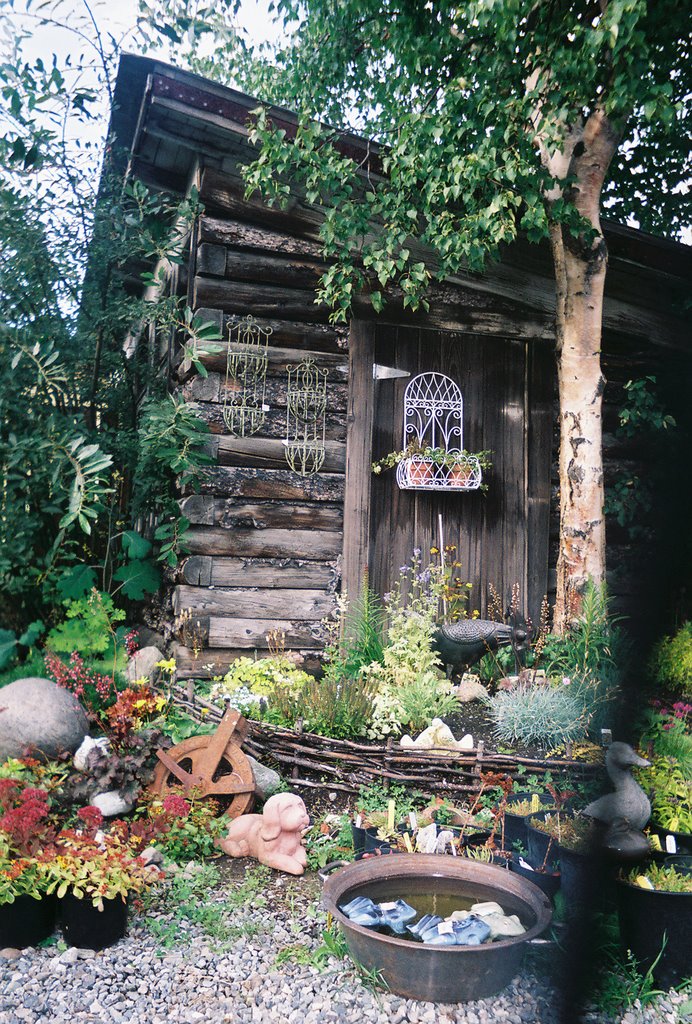
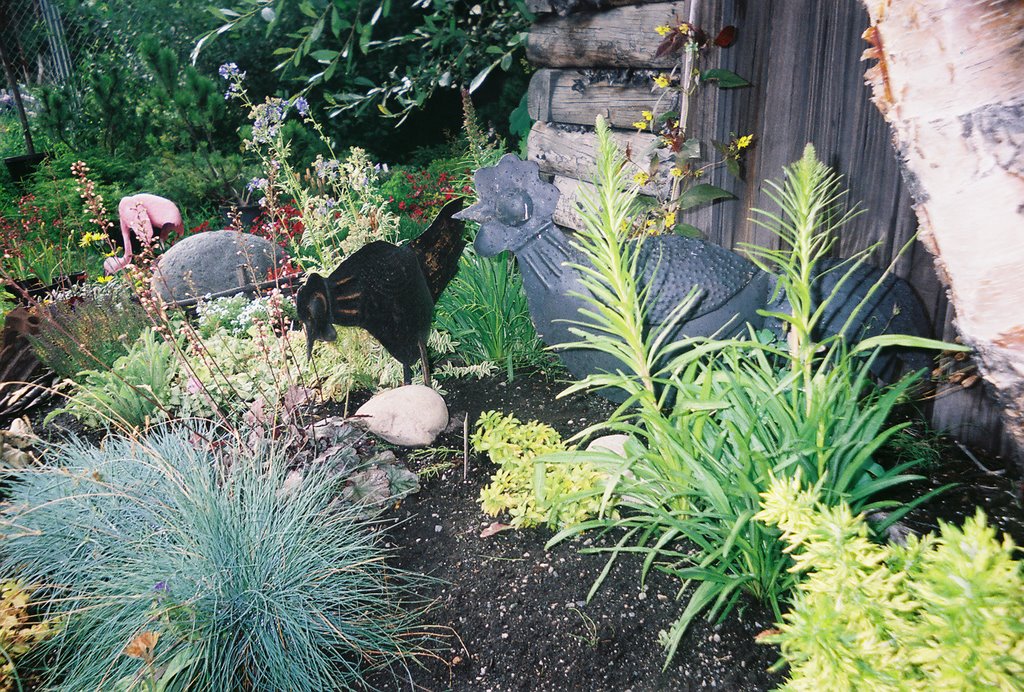
The 'Chicken Garden' at Stonehill Downtown

You're right, Brooke, this is what we all want long for time of year, but when it hits 68 degrees I start to sweat and can't stop. Hot is relative, I suppose since our hot is cold to some. But really, global warming is catching up to us - all those weeks of 70 and hotter were unheard of a few years ago. And oh, those apple varieties we can grow now - another unheard of gift from the destruction of the earths biosphere. Trash the earth but bring us apples...Hum, an interesting bumper sticker, don't you think?

The worst part of the whole business is keeping all those potted plants happy in the hot weather. It's enough to make me want to grow all our stock in the ground, but there's a significant problem: we don't have any ground! Our part of the mountain is one big lovely swamp, lots of soggy ground, running water, alders, devils club, willow and Moose, but very little soil. In fact, the gardens at the main nursery are all from man-made mixtures of this sort and that. One more year of struggling to keep pots cool. I agree, it looks like we're in for another hot one, though it's slow in coming.


DD Two

Ah, this photo is
more like it.
Now that's nice weather!
No rain, no brown, no sleet,
no frown!
Brooke

Gray, dreary, drizzle, and spring

DD Two

Ugh, it's chilly and drizzly and very gray-brown outside. But, there are little rosy-green things poking up through the dirt in front of the greenhouse. If the sun comes out a bit tomorrow there are a handful of squill that will open their blue eyes. Flowers in April! In Palmer, Alaska! Just think, only ten years ago I'd still be skiing in the back yard this time of year. Who says Global Warming isn't significant?

I've been watching slide shows of last summer trying to get my mind ready for gardening. With this drizzle...oops...I mean snow( it just turned into white stuff)watching digital slide shows beats pulling wintered-over plants out of the cold frames! The only thing I've done outside today is bring in more firewood for the big kitchen stove. It's cosier than turning up the thermostat. Ah, spring. Well, we do need the rain. This winter and last summer were too dry. The University of ALaska climatologists are predicting a hotter, drier summer than last year. Lots of forest fires and lots of hazey, smokey days are ahead. So, I guess this chilly drizzle isn't so bad after all. At least the air smells clean and fresh.

Friday, April 21, 2006

Spring chores - getting on

DD One
Getting on. Someone left a wonderful felt dog in my truck with a little scarf knitted from dog fur around its neck. I have seen the little creature at someone's house before, but don't remember where. Its bothering me. Such sweet sentiment, but from whom? No note.

Jay says the greenhouse will be done today. Hooray! The flowers are waiting. I am getting ready, I think. It will be interesting to see how the creative gray matter reacts to the smell and color of bedding plants. A healing effect, I hope.

I have been working on my spring designs, but without much zest. My clients seem quite happy, but I feel I have let them down. An acute lack of imagination would sum it up nicely. Still, the physical business of drawing, thinking and coloring is a relief. A mind-busy activity. Perhaps design classes for those in mourning would be the thing? I wonder if you would come out with a bunch of sorrowful looking gardens? Interesting thought.

I'm going to take my first walk through the nursery today and see how things are coming along. So far I have just peered through the fence. Its a mixed up mess over there - snow, mud and ice. I wonder if the soil in the soil building is thawed? That would be handy. It's always so much fun to thaw it out this time of year. The new roof Jay put over it last fall should have made all the difference. It would be good to be able to get to the potting shed without a foot of mud, but I have low hopes for that. I need stuff from there.

The boys will be here soon for tutoring. Writing is such a struggle for them and they work so hard at it. What a pleasure to have such fine young men to work with. They are sure to brighten (and confuse) the day. I look forward to it, as always.

Basil Erickson, Oct. 31, 1999 - March 24. 2006

DD one
Here is my beloved.

Surely you romp now in some heavenly plane, enjoying which was denied you here in this realm.

Thursday, April 20, 2006

Break up and loss

DD One
Mud everywhere! Dog tracks on the rugs, dog tracks in the car, dog tracks on my cloths.
The wind is cold, the water is running down the driveway and the mountains are crisp with new fallen snow. It makes the green grass popping out from under the porch somewhat surreal.

The guys nearly finished the new greenhouse today. I'm glad their working out there. I'm not quite ready to buck into the wind. The safety of the office seems cozy for me just now. When I am outside I miss Basil so much I can't focus. His beautiful eyes, his nose pushing my leg, his huge frame beside me, watching and patient. This will be a summer of sorrow and I am not ready for it. In the office, I changed my screen saver to his image, then quickly to something else. I was working through tears - the constant pain too real. I miss him beyond what I would ever have imagined, beyond reason and logic. The ache has settled in like an unwelcome visitor, keeping me raw and vulnerable inside.

The new, young dogs seem contented to play and watch, but Rosemary is melancholy. I'm afraid she will never be the same Rose that we have known. Basil was half of her, her joy, her brother. She needs time to refocus, shift, find a new spirit to life. I hope she finds it.

I need to focus as well. I need to find a spot of harmony and peace. Perhaps working in the earth will help. I am out of shape after a winter of sitting. I am out of focus. I am out of wack. I need to be on my knees in the dirt, moving rocks this way and that. I need to be so tired at night that memories and tears are not an option. I need the physical aches that summer brings to my aging body. Perhaps they will help the heart aches fade. I just need to get on with it.

There have been Robin songs the last couple of weeks, in spite of the cold. Thousands of Canadian geese have been in the grain field north of town. The tulips are up in the church garden, and primrose are up at Stonehill Downtown. There is sign of life everywhere as the Day of resurrection has come. Just grab onto it and fly, woman, just fly. So many things to do.
The plants are ready to move into the greenhouse as soon as it is done, perhaps in two days. The plants outside are frozen in, but each day they inch their way closer to a full thaw. I can see the tops of the perennial pots with some wonderful green emerging. The trees leaf buds are full and swollen, waiting for a week of warm weather to burst into unimaginable color.

I look forward to having the main nursery closed this summer. Perhaps we will enjoy the solitude so much that it will remain appointment only. That's a thought. But for now the gardens need major renovation. They are lovely and rambling, but make little sense anymore. They have been left a bit too much to their own devices and need to be reined in. I talk about it like it's a trifle, but work it will be! Heavy, bold, back breaking, wonderful work. A plan would be nice before we begin. Something at least more than a whisper in the back of my mind. I see it dimmed and unclear. I wish I could see my own gardens as clearly as I see those of others, crystal clear and finished, far before we begin. But Lola's Garden at Stonehill.....what a foggy, faded picture it is. I love it so, but can not see its next incarnation. I have a few more weeks to conjure it up, I'll just hope for a few good moments before then.

In the mean time I need to wrap my brain around getting on. All things in their own time I guess. All things in their own time.